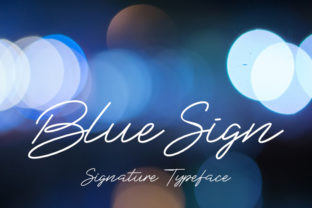
Blue Sign: A Script Handwritten Font for Timeless Branding
I was staring at a blank brand board, the kind that feels like a canvas waiting to be filled with something meaningful. I had just been handed a boutique identity project — a local coffee shop looking to refresh its visual language. The client wanted something modern yet warm, something that felt handcrafted but still professional. That’s when I reached for Blue Sign.
Blue Sign for Logo Design and Brand Identity
Blue Sign is a Script Handwritten font with a fresh, brush-like texture that feels both natural and refined. It’s not your typical script font; it has a certain elegance that makes it stand out in a sea of similar typefaces. When I first tested it on a logo concept, I was immediately drawn to its fluidity and subtle variations in stroke weight. It’s the kind of font that feels like it was written by hand, not generated by a machine.
For the coffee shop’s logo, I used Blue Sign as the primary text. It worked beautifully against a minimalist background, adding a touch of personality without overwhelming the design. I paired it with a clean sans serif font for the supporting text, creating a balance between warmth and professionalism. The result was a logo that felt approachable yet sophisticated — exactly what the client was looking for.
Blue Sign for Packaging Design and Product Labels
A few days later, I was working on packaging mockups for the same client. Blue Sign proved itself again, this time in a more subtle role. I used it for product labels and signage, where its natural look helped convey a sense of craftsmanship and care. On a matte white label, the font stood out without being too flashy. It added character to the packaging while maintaining readability, even in smaller sizes.
I also tested Blue Sign on a sample box mockup. The font looked great in both full-size and reduced formats, which is always a good sign. It didn’t lose its charm or legibility when scaled down, making it a versatile choice for various packaging needs. Whether it’s a small sticker or a large tag, Blue Sign holds up well.
Blue Sign for Social Media Graphics and Web Design
When designing social media assets for the coffee shop, I knew the font needed to work across multiple platforms. Blue Sign performed admirably here too. I used it in Instagram headers, Facebook banners, and even a website hero section. Its stylish hand-lettering gave the visuals a personal touch, while its clean lines ensured clarity on digital screens.
One thing I noticed was how Blue Sign handled different color contrasts. It looked stunning in deep blues and soft grays, but it also worked well with brighter tones. This versatility made it a go-to choice for creating eye-catching graphics that aligned with the brand’s aesthetic. I even considered using it for a short phrase headline on the homepage — it felt right, both visually and emotionally.
Blue Sign for Stationery and Editorial Design
Another project I worked on involved creating stationery for a creative studio. Blue Sign was perfect for letterheads, business cards, and brochures. Its classy look added a touch of sophistication without being too formal. I paired it with a simple serif font for body text, which helped maintain a cohesive visual hierarchy.
What I loved most about Blue Sign in this context was its ability to convey both creativity and professionalism. It felt like the ideal font for a design studio that values both artistry and structure. I also appreciated how it looked on printed materials — it retained its character and clarity, even after printing.
Blue Sign for Branding Projects and Commercial Use
As someone who regularly works with clients, I know the importance of choosing fonts that can stand up to real-world use. Blue Sign has been tested in several branding projects, including a handmade shop identity and a skincare product line. In each case, it delivered consistent results, whether used as a headline, accent, or display font.
That said, I wouldn’t recommend Blue Sign for long body text or very small sizes. It’s best suited for short phrases, logos, and decorative elements. If you’re working on a project that requires extensive text, consider pairing it with a more readable serif or sans serif font. Also, always check the commercial licensing before using it in client work, especially for print-on-demand products or branded merchandise.
Blue Sign for Designers Looking for a Premium Script Font
If you’re a designer searching for a Script Handwritten font that balances style with practicality, Blue Sign is worth considering. It’s not just another trendy typeface — it’s a tool that can elevate your designs with its natural, classy look. Whether you’re working on a logo, a social media post, or a product label, Blue Sign has the versatility and character to make an impact.
Its inclusion of stylish hand-lettering and natural variations adds depth to any design, making it feel more human and authentic. Plus, it’s designed to work across multiple platforms and mediums, which is a huge plus for designers who need fonts that adapt to different contexts.
In the end, Blue Sign isn’t just a font — it’s a design asset that can help shape the identity of a brand. It’s the kind of typeface that feels like it was created with purpose, and that’s something I value greatly as a designer.